
Latest News
Made In Africa Sport launches AI-powered supercomputer for 2026/27 NPFL season

Made In Africa Sport (MIAS), a technology and media company, has launched a new supercomputer model npfl.madeinafricasport.com designed to analyse and predict all 380 matches in the 2026/27 Nigeria Premier Football League (NPFL) season.
The NPFL season begins on 28 August, with 20 teams set to compete across 38 matchdays.
Ahead of the opening round, the MIAS model has analysed every fixture and produced predictions covering expected scores, goals and match outcomes.
The system is built around more than 8,000 historical NPFL matches in the MIAS database, giving it access to one of the most extensive collections of historical league data available on the competition.
To generate its season projections, the supercomputer runs 100,000 Monte Carlo simulations for each of the 380 fixtures, producing 38 million simulations. Each simulation uses the model’s calculated probabilities to generate possible match outcomes, allowing the system to assess the range of scenarios that could shape the final league table.
The predictions will be updated as the season progresses, each matchday, allowing the model to respond to new results and changes in clubs’ performance.
Rather than simply predicting which team will win, the model also estimates how likely each club is to finish in every position on the final table, including its chances of winning the title, qualifying for continental competition or being relegated.
The full NPFL 2026/27 predictions, including match outcomes, expected goals, team ratings and the projected league table, are available on the MIAS Supercomputer.
Explore the MIAS Supercomputer here: npfl.madeinafricasport.com
Speaking further on the launch, Executive Director of MIAS, Enitan Obadina, revealed the product was created to address a gap in how the NPFL is analysed and discussed.
“For a league with as much history as the NPFL, we still do not use enough of the data we have,” Obadina said.
“Every week, there are conversations about which team is in form, who will win a match or who is likely to challenge for the title, but a lot of those conversations are based on opinion and eye-test.
“What we are trying to do is put a proper data layer behind those conversations. We have gone through thousands of historical matches and built a system that can turn that information into something people can actually use to understand the league.”
How does the MIAS supercomputer work?
The model combines historical and recent performance data with information on head-to-head records, venue strength, goalscoring and transfer activity.
For each fixture, these factors are assessed to produce the likelihood of a home win, draw or away win.
Recent form is the most important factor and looks at a team’s last five matches. Away victories are given additional weight because winning away from home is particularly difficult in the NPFL.
The model also considers previous meetings between the two teams and how they have performed at home and away. This helps account for the strong home advantage that has historically been a feature of the NPFL.
Goalscoring form is assessed using the number of goals a team has scored and conceded in its recent matches, while transfer activity allows the model to account for changes in squad quality that may not yet be reflected in previous results.
The final prediction shows which outcome has the highest probability, alongside the expected goals and other factors that contributed to the result.
For example, the model could produce a prediction of 58 per cent for a home win, 24 per cent for a draw and 18 per cent for an away win.
Obadina said the intention was not to present the model as a replacement for football knowledge or judgement, but as another tool for understanding the competition.
“We are not saying the computer knows what will happen. Football does not work like that. What it can do is show the probability based on the evidence available to it, and that gives you a much better starting point than simply saying a team will win because it looks stronger on paper.
“The important thing for us is that people can see how a prediction was reached. If we say a team has a 60 per cent chance of winning, there is data behind that number and the user can see the factors that contributed to it.”
Beyond win, draw or loss
The MIAS Supercomputer system also estimates the number of goals each team is expected to score, alongside its attacking, defensive and transfer strength.
The ratings are relative to the average NPFL team, with 1.00 representing the league average.
An attacking rating of 1.07, for example, means the model considers a team to be seven per cent better than the average team in that area. Defensive ratings work differently: a figure below 1.00 indicates a stronger defence because it represents fewer goals conceded.
Transfer strength is scored on a separate scale, based on a player’s previous season performance, allowing the model to account for changes that historical match data cannot capture, particularly as NPFL clubs always overhaul their squads during the transfer window.
Why home advantage matters
One of the model’s defining characteristics is how it treats home advantage.
MIAS has built the system specifically around the characteristics of the NPFL rather than applying a generic football prediction model.
Historical data shows just how significant home advantage is in the league. Since 2003, away teams have won only 601 of the 7,966 NPFL matches played, meaning just 7.5 per cent of all games have ended in an away victory.
The approach is intended to ensure that the predictions reflect the realities of Nigerian domestic football rather than patterns from European or other international leagues.
How the season table is projected
After calculating individual match probabilities, the system simulates the entire NPFL season millions of times.
By repeating the process 38 million times, MIAS Super Computer can calculate how frequently each team finishes in every league position.
This means a team can be given not only a predicted finishing position but also an indication of its chances of winning the title, finishing in continental places or being relegated.
A model built for the NPFL
The MIAS Supercomputer has been designed specifically for the Nigerian league and is based on historical NPFL data rather than a generic international football model.
The model also gives greater weight to recent seasons, recognising that teams, coaches and playing squads change over time. Where there is limited data on a team, its ratings are gradually pulled towards the league average rather than allowing a small sample of results to produce an extreme prediction.
Obadina said the 2026/27 launch was intended to be the starting point for a broader data product rather than a one-season project.
“This is the first major version of what we want to build. We want to keep improving it as more NPFL data becomes available, so that the model becomes more useful from one season to the next.
“The bigger ambition is to build a reliable data infrastructure around African football. We want to get to a point where journalists, clubs, analysts, supporters and other stakeholders can ask meaningful questions about our leagues and have credible data to work with,” he concluded.
About Made In Africa Sport
Made In Africa Sport (MIAS) is a sports technology and media company using data analytics, artificial intelligence, machine learning and digital innovation to build solutions for African sport.
Alongside its technology products, MIAS uses journalism and content creation to tell the stories of African athletes, competitions and sporting communities across the continent.
Its long-term ambition is to become the continent’s leading sports technology company, creating products that can be used by clubs, athletes, media organisations, federations and fans while helping African sport become more exposed and commercially valuable.
The post Made In Africa Sport launches AI-powered supercomputer for 2026/27 NPFL season appeared first on Made In Africa Sport.

Nigeria’s women football team, the Super Faclcons captain, Rasheedat Ajibade is among the selected thirteen football players to participate in the second edition of FIFA Player Impact Programme.
The programme is aimed at driving social change and designed to empower players to use their influence to create positive social change.
Ajibade joins a diverse group of international stars, including the 2023 FIFA Women’s World Cup winner Alexia Putellas, England forward Michelle Agyemang, Zambia‘s Racheal Kundananji and former India captain Sunil Chhetri, who is the programme’s first male participant.
Ajibade among 13 players driving social impact
The 13 participants represent different countries and football backgrounds, with each expected to develop an initiative focused on a cause that matters to them.
According to FIFA, education, mental health and equitable access to sport are among the key areas the players are seeking to address through their projects.
The programme provides tailored support from FIFA and an external specialist in sport for social impact, helping participants transform their ideas into practical initiatives.
Although FIFA has not detailed Ajibade’s individual project, her inclusion provides an opportunity for the Nigerian international to contribute to the programme’s wider goal of using football as a platform for positive change.
Ajibade’s social impact work
Known affectionately as “The Girl with the Blue hair,” Ajibade’s inclusion highlights her ongoing dedication to humanitarian efforts off the field.
Through her own Rasheedat Ajibade Foundation, she has already spearheaded multiple social initiatives in Nigeria.
She set up educational scholarships and football workshops that identify and promote grassroots talent, helping give young people opportunities to succeed
Ajibade implemented ‘The Rash Tech Scholarship’ – a program providing free technical skills training to 60 young people across Nigeria.
Following their historic ‘Mission X’ title win at the 2024 Women’s Africa Cup of Nation, held in 2025, Ajibade, alongside her Super Falcons teammates launched a grassroots sports development framework that distributes critical training equipment to over 150 local female football teams.
In 2026, through her Rasheedat Ajibade Foundation, she sponsored grassroots coaches to obtain advanced professional certifications through the National Institute for Sports (NIS).
Players begin impact journey in Boston
The FIFA Player Impact Programme is designed to empower players to drive positive change in causes and communities that matter to them.
Education, mental health, and equitable access to sport are among the main causes championed by the footballers taking part.
The second cohort officially began its journey in June, when Ajibade and 10 of the 13 participants gathered in Boston, Massachusetts, for a three-day Impact Accelerator Workshop.
Through group discussions, practical exercises and expert-led sessions, the players explored how their personal experiences and influence could help address social challenges.
The workshop also provided an opportunity for participants to share their stories, exchange ideas and develop a clearer understanding of how to turn their proposed projects into reality.
FIFA Chief Football Officer Jill Ellis, who met with the participants in Boston, highlighted the responsibility footballers have to create a legacy beyond their achievements on the pitch.
“Today we have a reach that extends far beyond 90 minutes. Through social media and the platforms available to us, we have an incredible opportunity not only to connect with fans, but to influence communities, create opportunities for others and drive meaningful change,” Ellis said.
December presentation marks next milestone
The next stage of the nine-month programme will take place in December, when participants gather in London, with others joining virtually, to present their projects to their peers.
The presentations will mark another important step in the players’ efforts to translate their ideas into initiatives capable of making a lasting difference in their communities.
The FIFA Player Impact Programme reflects the growing recognition that footballers can influence society beyond their performances on the pitch, using their platforms and personal experiences to inspire opportunities and address important social issues.
The total players list released by FIFA for the second edition are;
Alexia Putellas – Spain
Casey Phair – Korea Republic
Gabi Nunes – Brazil
Hina Sugita – Japan
Jessie Fleming – Canada
Kenza Dali – France
Maria Sanchez – Mexico
Michelle Agyemang – England
Phallon Tullis-Joyce – USA
Racheal Kundananji – Zambia
Rasheedat Ajibade – Nigeria
Rebekah Stott – New Zealand
Sunil Chhetri – India
The programme offers an opportunity to Ajibade to be part of a global group of footballers working towards that shared objective.
The post Rasheedat Ajibade Ajibade joins FIFA Player Impact Programme to drive social change appeared first on Made In Africa Sport.
The Confederation of African Football (CAF) has rescheduled the 2026 CAF Awards ceremony to Wednesday, December 2, in Lagos, Nigeria, bringing forward the continent’s prestigious football celebration by five days.
The announcement was made on Tuesday, November 10, with the ceremony scheduled to begin at 7:00 p.m. Nigerian time (6:00 p.m. GMT and 8:00 p.m. Cairo time).
The event will take place at the Professor Wole Soyinka Centre for Culture and the Arts, formerly known as the National Theatre, where Africa’s leading footballers, coaches, administrators and other sporting personalities will converge to celebrate outstanding achievements in the game.
Lagos Returns to the CAF Awards Calendar
The 2026 edition marks the return of the CAF Awards to Lagos for the first time since 2014, giving Nigeria’s commercial capital another opportunity to showcase its cultural heritage and capacity to host major continental sporting events.
The city has previously hosted the ceremony in 2008, 2013 and 2014, making the upcoming edition another significant milestone in its history with African football.
The decision to bring the awards back to Nigeria was earlier confirmed by CAF following its Executive Committee meeting in October. The initial date announced was December 7 before the governing body confirmed the new December 2 schedule.
18 Categories to Be Recognised
According to CAF, the 2026 ceremony will feature 18 award categories, with the Men’s Player of the Year and Women’s Player of the Year awards expected to attract significant attention.
Other categories will recognise outstanding contributions from coaches, goalkeepers, emerging talents, clubs and national teams across both men’s and women’s football.
The awards remain an important platform for recognising individual brilliance and collective achievements throughout African football.
Voting Process Underway
Meanwhile, voting for the 2026 awards is already underway and will run from November 5 to November 20 across the men’s and women’s categories.
CAF disclosed that the process involves its Member Associations and clubs, with eligible coaches and captains participating directly in selecting the outstanding performers.
The governing body also emphasised that the voting procedure is designed to promote fairness, transparency and broad representation, with independent monitoring put in place to protect the integrity of the results.
Nigeria’s Opportunity to Shine
Nigeria’s return as host comes after a successful period for its representatives at the awards.
Ademola Lookman won the Men’s Player of the Year award in 2024, following Victor Osimhen‘s triumph in 2023. Nigeria’s Super Falcons have also enjoyed considerable success, winning the Women’s National Team of the Year award in 2023, 2024 and 2025.
At the 2025 edition in Rabat, Morocco, Achraf Hakimi and Ghizlane Chebbak claimed the men’s and women’s top individual honours respectively.
With the December 2 date now confirmed, attention will turn to the final voting process and preparations for what promises to be a memorable celebration of African football in Lagos.
The post CAF brings 2026 Awards ceremony forward to December 2 in Lagos appeared first on Made In Africa Sport.

Nigerian footballers made their mark across European leagues over the weekend, with Tolu Arokodare and Kelechi Iheanacho leading the way through their goalscoring contributions for Ajax and Bursaspor.
Arokodare extended his scoring run to five consecutive matches in the Netherlands, while Iheanacho returned to the scoresheet in Turkey to take his league tally to 17 goals. Gift Orban, Yira Sor, Dapo Afolayan and other Nigerian players also contributed for their respective clubs between November 6 and 8.
Arokodare extends scoring streak in the Netherlands
Tolu Arokodare continued his impressive scoring form for Ajax, finding the net in their 2–2 draw against FC Twente at De Grolsch Veste on Sunday.
The Nigerian striker opened the scoring just three minutes into the encounter, rising above his marker to meet Oscar Gloukh’s delivery with a powerful header.
The goal extended his scoring streak to five consecutive matches and took his Eredivisie tally to seven goals. He now has 13 goals and four assists in 17 appearances across all competitions.
Ajax appeared on course for victory after Rayane Bounida doubled their advantage in the 66th minute. However, an own goal by Dies Janse two minutes later gave Twente a route back into the contest before Wout Weghorst converted a stoppage-time penalty to secure a point for the hosts.
Iheanacho returns to scoring as Bursaspor stay top
In Turkey, Kelechi Iheanacho ended his recent spell without a goal by scoring in Bursaspor’s 1–1 draw against Antalyaspor in the TFF First League on Friday.
The Super Eagles forward put Bursaspor ahead in the 26th minute, finishing inside the penalty area after receiving a delivery from Amine Boutrah.
Iheanacho had opportunities to increase his side’s lead, including an effort that was ruled out for offside. However, Bursaspor failed to preserve their advantage, with Toral Bayramov’s own goal restoring parity before half-time.
Neither side found a winner after the break, leaving the teams to share the points.
The strike took Iheanacho’s league tally to 17 goals in 14 appearances, alongside four assists. His previous run of scoring in 12 consecutive league matches had ended against Bandirmaspor.
Bursaspor remained top of the standings with 32 points.
Orban and Sor score in seven-goal thriller
Gift Orban and Yira Sor were both on target as Amedspor lost 4–3 to Galatasaray in a seven-goal encounter in the Turkish Super Lig on Saturday.
Orban reduced the deficit in the 65th minute with a header after Amedspor had fallen three goals behind. The goal took his league return to 10 goals and four assists in 11 appearances.
Sor also found the net in stoppage time, scoring in the 92nd minute on his return from a two-month injury absence. Their efforts, however, were not enough to prevent Amedspor from suffering defeat.
Afolayan scores against former club
Dapo Afolayan scored as Blackburn Rovers secured a 2–1 victory over West Ham United at Ewood Park.
The Nigerian forward, who previously played for West Ham, doubled Blackburn’s advantage in the 71st minute with a low finish into the bottom-right corner.
West Ham pulled a goal back, but Blackburn held on to claim all three points.
Akere provides two assists in Poland
Samuel Akere registered two assists for Wisła Płock in their 3–2 defeat to Motor Lublin in Poland.
The Nigerian winger set up Afonso Rodrigues Silva and Olaf Kobacki in the 30th and 32nd minutes, helping Wisła Płock recover from an early setback and take a 2–1 lead.
Motor Lublin eventually claimed victory with a late goal after Wisła Płock had been reduced to 10 men.
More Nigerians make contributions across Europe
Elsewhere, Ehije Ukaki opened his scoring account for the season with a goal for Botev Plovdiv in their 1–1 draw against Dunav Ruse in Bulgaria.
In Turkey, Ibrahim Olawoyin provided an assist as Çaykur Rizespor defeated Erzurumspor 2–1, while Paul Onuachu and Chibuike Nwaiwu each registered an assist in Trabzonspor‘s 2–0 win over Alanyaspor.
In England, Alex Iwobi and Calvin Bassey featured for Fulham in their 1–1 draw against Newcastle United. Iwobi completed 90 per cent of his passes, while Bassey recorded seven clearances and four recoveries.
Semi Ajayi also featured for Hull City against Arsenal, winning seven of his eight duels before being forced off through injury.
The weekend’s performances highlighted the contributions of Nigerian players across several European competitions, with goals, assists and defensive displays from established internationals and other players continuing to draw attention as the international break approaches.
The post Eagles Watch: Arokodare extends scoring streak as Iheanacho reaches 17 league goals appeared first on Made In Africa Sport.
-
 Athletics1 month ago
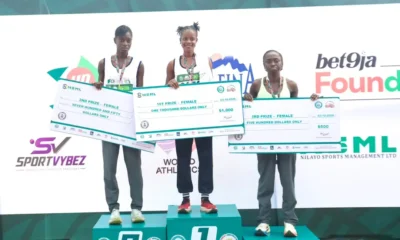
Abeokuta 10km Race winners praise organisers after ₦6m prize payout
-
Featured3 months ago
Bet9ja Foundation Ex-Internationals Cup: Babington Lift Giant Trophy, Pocket ₦2.5m After 3–1 Final Win
-
 Basketball7 months ago
PBA slaps ₱20k fine on Calvin Abueva for F2 upgrade vs Magnolia
-

 DLSU9 months ago
Shan Nunag shows composure beyond year in La Salle debut
-

 News9 months ago
Camilla Lamina shows calm leadership even off the bench
-
Football9 months ago
2026 Uganda Cup: The confirmed fixtures, venues & kick off times at round of 32
-
Foreign Pros9 months ago
‘Eric Chelle must pay compensation to quit Super Eagles post’
-
Others9 months ago
Sarah Babirye Kityo: The majestic return to 12th Parliament, to front sports talent development