
Badminton
Shan Clar, Susmita Ramos lead UP title haul in MIA Badminton Cup

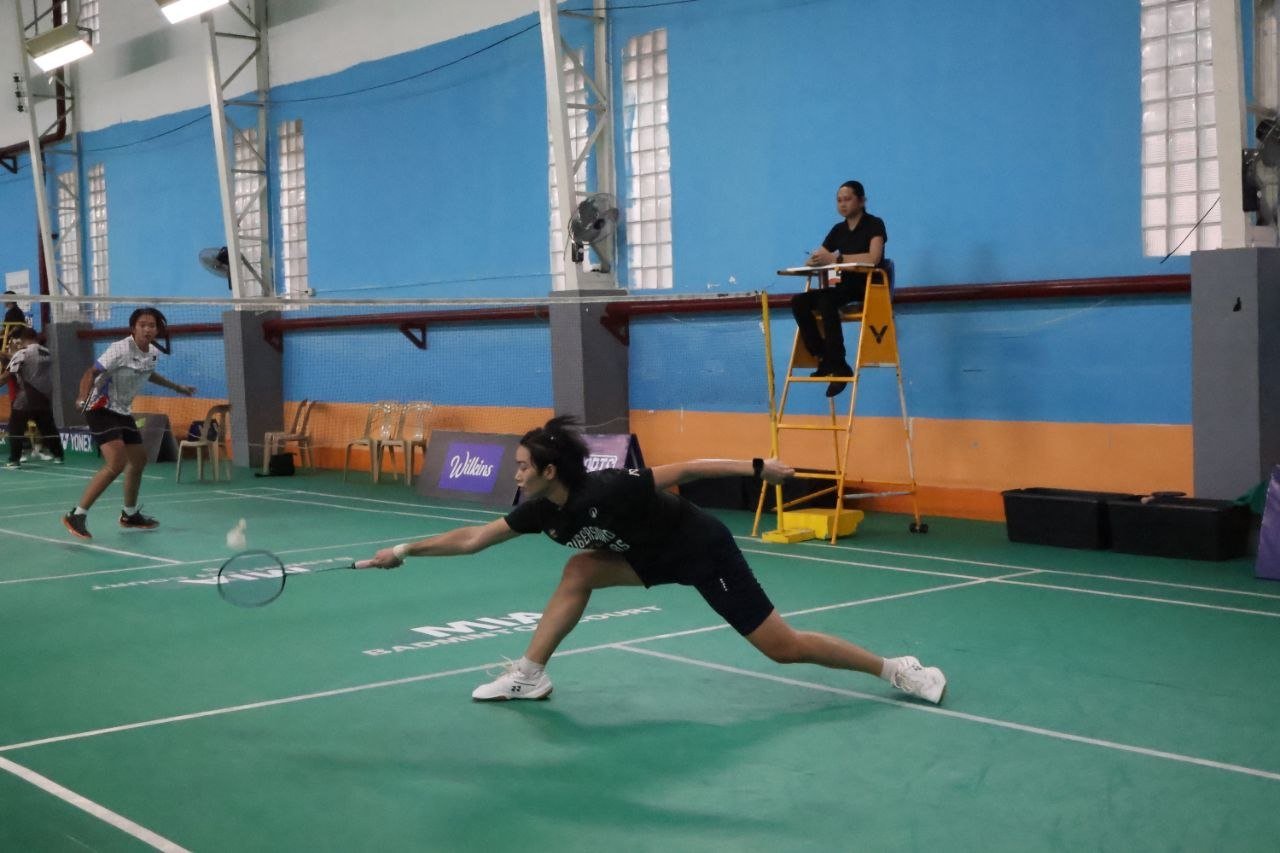
Shan Clar and Susmita Ramos emerged as the Men’s and Women’s Singles Open champions of the 2026 MIA Badminton Challenge Cup after pulling off unexpected sweeps on Friday at the MIA Sports Center in Pasay City.
Clar and Ramos, both standouts from the University of the Philippines, defeated higher-seeded opponents to claim the top prizes in the tournament backed by Rally Sports, JPA Sports, Wilkins Pure, Minute Maid, and Playa de Nubla Private Resort.
Clar, the UAAP Season 87 Rookie of the Year and the country’s No. 12 player, needed just 28 minutes to turn back top seed and Philippine No. 4 Rabie Oba-ob, 15–13, 15–8.
“Since nag-start naman, ang iniisip ko talaga, hindi ko siya sineset lang sa ngayong laro, na every panibago siyang laro, panibago siyang feeling, maging present lang ako,” said the incoming third-year Fighting Maroon, explaining his mindset heading into the final day.
Now a champion, Clar hopes the victory will fuel him toward further success, particularly as he prepares to lead the UP men’s team in the upcoming UAAP competitions.
“Siguro sa mga susunod na tournament, hindi ko dapat isipin na nag-champion ako, kundi kung paano ko pa rin ‘to nakuha. Yung hard work pa rin at hindi nagkukumpiyansa,” he shared.

(C) Susain Palgue/MIA Badminton
Ramos, meanwhile, the incoming UP women’s team captain, needed 24 minutes to claim the Women’s Singles Open title at the expense of co-top seed and incoming sophomore teammate Brys Fuggan, 15–11, 15–13.
“Ang motivation ko po talaga is to get back to my peak performance po talaga, since last year it was a bad performance, especially coming from injury. I want na since malapit na ‘yung season, mapakita ko na prepared ako at ready to play for the UAAP, “ said Ramos, a former Smash Pilipinas member shared.
Ramos, who was part of the women’s team that secured a bronze medal for the Philippines at the 2025 SEA Games, emerged as the tournament’s biggest winner after also capturing the Women’s Doubles Open title with her UP co-captain Kimberly Lao.
The two Fighting Maroons seniors outlasted their teammates Anthea Gonzalez and Nikki Paz, 15–13, 8–15, 15–10, in 39 minutes.
Enzo Rivera and Krissa De Leon made it four titles for the Quezon City-based side after outlasting former National University standouts Mike Minuluan and Sarah Joy Barredo, 15–10, 15–10, in the Mixed Doubles Open final.
Mike Maratas and Nestojan Tapales captured the remaining Open title, taking the Men’s Doubles crown over UP-Allied’s Micheal Clemente and Rally Sports’ Neil Pineda, 16–14, 15–11.
Clar and Ramos pocketed P10,000 each and received gold medals, while the doubles champions also took home P10,000 apiece.
The runners-up received P5,000 and silver medals, while the remaining semifinalists earned P2,500 and bronze medals.

(C) Susain Palgue/MIA Badminton
In the age-group events, World Juniors Championships-bound Roaquine Ramos collected two crowns in the Boys’ Doubles and Mixed Doubles Under-18 events.
Ramos teamed up with Stephen Pantuan as the Philippine International Junior Series semifinalists outhustled Whackers Badminton Development Center’s Van Joel Lucas and Glihord Suladay, 21–20, 16–14, in the Boys’ Doubles final.
The 17-year-old upstart closed out the day with a 15–10, 15–11 victory alongside Enya Almazan over Louise Bernardino and Andie De Leon in the Mixed Doubles Under-18 final.
The tournament is far from over as it now shifts the spotlight to the masters level, with doubles events for the 30-and-above and 40-and-above age groups.
The post Shan Clar, Susmita Ramos lead UP title haul in MIA Badminton Cup appeared first on Tiebreaker Times.


AirBadminton may look familiar to anyone who has watched traditional badminton, but once the AirShuttle takes flight, the differences quickly become apparent. The outdoor version has its own court, its own service rules, three different playing formats and a scoring system designed to produce fast, competitive matches.
For spectators heading to Aero Beach, Entebbe, understanding those details makes the action much easier to follow.
Who plays?
AirBadminton can be played in three principal formats:
- Singles: one player against one player.
- Doubles: two players against two players.
- Triples: three players against three players.
The triples format is one of the biggest distinctions from conventional badminton.
In triples, players cannot make two consecutive returns. If one player makes a return, the next return must come from a teammate.
That means a triples team cannot simply depend on one player to dominate every rally. Players have to communicate, move intelligently and understand when and where their teammates will make the next shot.

The AirBadminton court
The court is 16 metres long.
For doubles and triples, it is six metres wide, while the singles court is five metres wide.
But perhaps the most noticeable difference is the two-metre dead zone close to the net.
The dead zone exists because shots played very close to the net are more difficult to control outdoors with the AirShuttle. It encourages players to construct rallies further away from the net.
Players cannot step into the dead zone to make a stroke. They can, however, step or land there after making a legal stroke before returning to their playing area.
That small area can become a major tactical factor. A player who misjudges the space around the net can give away a point, while a player who understands how to use the court can force an opponent into difficult positions.
How does the serve work?
The service is different from traditional badminton. There is a three-metre service marker on each sideline. The server must serve from behind the marker with both feet stationary.
At the point of contact, the entire AirShuttle must be below the height of the net and its trajectory must travel upwards from the racket.
There is also no centre line dividing the service area into left and right service boxes. In doubles and triples, the serve can be directed into the opposition’s playing area and any player on the receiving side can return it.
Once the serve is returned, the rally continues until the AirShuttle hits the ground or a fault occurs.
How are points scored?
AirBadminton uses the rally-point system.
That means every rally produces a point for one side.
It does not matter who served. If you win the rally, you get the point.
If your opponent commits a fault, you get the point.
The recommended BWF format is best of five games, with each game played to 11 points.
There are, however, special rules when the score gets tight.
If the score reaches 10–10, a player or team must win by two clear points.
So:
- 11–8 — game over.
- 11–10 — game over.
- 12–10 — game over.
- 12–12 — the next point wins.
- 13–12 — game over.
Therefore, 13 is the maximum score in a game under this format.
The first side to win three games wins the match. A match can consequently finish 3–0, 3–1 or 3–2.

What is a fault?
A fault is essentially an action that breaks one of the rules of play.
When a fault occurs, the rally ends and the opposing side receives the point. That makes every mistake costly.
A player can commit a fault by;
- Failing to clear the net: If the AirShuttle does not pass over the net, the player or side that hit it loses the rally.
- Hitting the AirShuttle out: If the AirShuttle lands outside the court boundaries, the opposition wins the rally. Important to note, a shuttle landing on the boundary line is considered in.
- Landing in the dead zone: If the AirShuttle lands in the two-metre dead zone beside the net, it is a fault.
- Stepping into the dead zone to play the shuttle: Players cannot enter that zone to make a stroke.
- Touching the net: Touching the net or its supports with the racket, body or clothing during play is a fault.
- Catching or carrying the AirShuttle: A player cannot hold the AirShuttle on the racket and sling it across the net. It must be struck properly.
- Double hitting: A player cannot hit the AirShuttle twice consecutively. In triples, this becomes even more important because the next return must come from a teammate.
- Touching the AirShuttle with the body: If the AirShuttle touches a player’s body or clothing during play, it is a fault.
There are also rules against deliberately obstructing an opponent or using deliberate actions to distract them.
What happens after a fault?
The rally ends immediately, and the opponent gets the point. That is what makes AirBadminton’s rally-point system particularly unforgiving. A single mistake can directly change the score.
An incorrect serve, an AirShuttle into the dead zone, a shot out of bounds, a shuttle that fails to clear the net, or an illegal touch can all hand the opposition a point.
Who wins?
There are two winners to identify. First, there is the game winner. That is the side that reaches 11 points first, subject to the rules governing 10-all and 12-all.
Then there is the match winner. Under the recommended best-of-five format, the first side to win three games wins the match.
So, if a player wins the first three games, the match ends 3–0.
If the players split the first four games, the fifth game becomes decisive.
The side that wins a game also serves first in the following game.
AirBadminton is a sport where accuracy, movement, decision-making and discipline all matter. For the spectator, the scoring is simple: win the rally, win the point.
For the player, however, every rally presents another decision. And at a championship featuring 14 countries, those small decisions could ultimately determine who walks away with the continental crown.
The post AirBadminton: How the Game Works appeared first on Kawowo Sports.


Hosting the Africa AirBadminton Championships in Uganda is one thing. Winning it on home soil is another.
For Uganda’s eight-player team, the return of the continental championship is therefore more than a homecoming. It is a test of whether the country can turn its early advantage in AirBadminton into sustained continental dominance.
Uganda enters the 2026 championship carrying the confidence of having won a previous continental edition in Mauritius. But the circumstances have changed considerably. The tournament has grown from four participating countries in Mauritius to nine in Ghana, and now to 14 nations in Uganda, with more than 120 participants expected.
AirBadminton is no longer simply an experimental outdoor version of badminton. Across Africa, more countries are beginning to understand its possibilities, and Uganda will have to prove that its previous success was the beginning of something bigger rather than a one-off achievement.
Uganda’s preparation has been built around an eight-player team four boys and four girls with the majority drawn from the squad that won gold in Mauritius, although there have been changes.
The players have spent about three months preparing, training at Mbogo High School under coach Kabindi. The preparation has also had to account for the unique demands of AirBadminton. Unlike traditional badminton, where players operate in a controlled indoor environment, AirBadminton introduces wind, sand and changing outdoor conditions into the contest.
That makes adaptability just as important as technical ability. And Uganda’s technical team is under no illusion that the previous title guarantees anything.
Other countries have had time to prepare. The competition has expanded, and nations arriving in Entebbe will not simply be making up the numbers.
Simon Mugabi, the CEO of Badminton Uganda, has stressed that Uganda cannot afford to rely on the success achieved in Mauritius. The championship is bigger; the field is wider, and the expectations around the hosts are higher.
The challenge, therefore, is not simply to defend a trophy. It is to defend Uganda’s credibility as one of the continent’s leading AirBadminton nations.
The team format adds another layer to Uganda’s challenge. With four boys and four girls, the selected players are expected to contribute across doubles and triples, meaning versatility becomes a valuable weapon.
Triples, in particular, change the rhythm of the game. With three players on court, communication, positioning and movement become critical, while the rule requiring teammates to alternate consecutive returns means players cannot simply rely on one dominant athlete to control every rally.
For Uganda, this could be an advantage because the team already has experience of the discipline at continental level. But familiarity alone will not win matches.
The players must manage the conditions, read the wind, protect their court positions and make quick tactical decisions. At Aero Beach, Entebbe, the environment itself becomes part of the contest.
The sand can affect movement and balance. The wind can alter the trajectory of the AirShuttle. And because there is no indoor roof shielding the players from the elements, conditions can change the way a match is played.
In AirBadminton, the surroundings are not merely a backdrop. They are part of the opponent. The choice of Aero Beach is also significant. The championship takes badminton outside the traditional indoor setting and places it in an environment where the sport can be seen, experienced and understood differently.
For Uganda, this fits the wider philosophy behind AirBadminton: taking the sport beyond the walls of conventional badminton facilities and making it possible to play on outdoor surfaces such as sand, grass and hard courts.
That could prove particularly important in Uganda. The country has had limited access to indoor badminton infrastructure, but AirBadminton offers a version of the sport that does not depend entirely on traditional indoor facilities.
Uganda has already experimented with the discipline through unofficial events, including activities on a hockey pitch and at Mbogo High School in 2023.
Now, the 2026 championship has been officially gazetted by the Badminton World Federation and the Badminton Confederation of Africa. That represents an important step from experimentation to structure.
The growth of the championship is perhaps the clearest indication of where AirBadminton is heading. The participating nations include countries such as Algeria, Tunisia, Nigeria, Egypt, Benin, Kenya, Rwanda, Burundi, Comoros, Zimbabwe and Zambia alongside Uganda.
The increase is not merely numerical. It means Ugandan players will encounter a broader range of playing styles and approaches, while other nations will also be gaining experience from competing against the defending champions.
The previous Ghana championship underlined how competitive the event can become. Egypt emerged victorious, with Nigeria finishing second, while Uganda was unable to qualify because of external circumstances.
That makes the 2026 tournament an opportunity for Uganda to re-establish itself at the top. But doing so at home comes with its own pressure.
The hosts are expected to perform, and every advantage knowledge of the environment, previous experience and preparation must be converted into results.
The championship itself is only part of Uganda’s AirBadminton Week.
Following the Africa AirBadminton Championships from September 16–19, Uganda will host the Zone 5 Regional Championships and a BWF/BCA AirBadminton Training Camp from September 20–22.
That extension is important because it gives the country something beyond medals.
It creates an opportunity for athletes, coaches and officials to gain more exposure to the discipline and build capacity around it.
The training camp also fits into the larger ambition of establishing AirBadminton as a meaningful part of badminton development rather than treating it as a temporary variation of the traditional game.
Badminton Uganda has been clear that AirBadminton is not intended to replace conventional badminton. Instead, it is another route into the sport.
A child who may never have access to an indoor badminton court can potentially encounter the game outdoors. A community without specialised infrastructure can have another way to participate. And players who already understand badminton can develop another set of tactical and physical skills.
That is where the long-term value of AirBadminton may lie. Use the championship to create a stronger foundation for AirBadminton beyond September.
The country has already been part of the discipline’s African journey from its early continental tournament in 2021. It has now returned to the continental spotlight with the biggest field yet.
The question is what happens after the final point.
If Uganda can combine competition with development, the championship could leave behind more than a winner. It could strengthen coaching, expand participation and give more Ugandans an opportunity to see badminton as a sport that does not have to be confined to four walls.
The AirShuttle will fly. The wind will test them. The sand will slow some movements and reward others. And somewhere between those conditions and the pressure of defending a continental crown, Uganda will discover whether its first AirBadminton success was a foundation or simply a moment.
The post AirBadminton: Uganda’s Home Test appeared first on Kawowo Sports.


The shuttle is flying far beyond Kampala. From classrooms in Eastern Uganda to dusty school grounds and hard courts in the countryside, badminton is quietly building a new army of players, and Shuttle Time is at its heart.
What started as a BWF initiative to take badminton to the remotest corners of the world has grown into one of the sport’s most effective grassroots engines.
The frequent mention of “Shuttle Time” among sports fanatics is therefore no miracle. It is consistency creating magic.
And the numbers are beginning to tell the story. Badminton Uganda has now pushed into more than 30 districts, including Bugweri, Bugiri, Namutumba, Ngora, Pallisa, Padel, Katakwi, Kaberamaido, Karaki, Butebo, Mayuge, Rubirizi, Nakaseke, Iganga, Kaliro, Buyende and Kamuli, among others.
The expansion also fits neatly into the National Sports Act, which requires sports to go beyond traditional urban centres.
The law gives community and grassroots sports organisations a chance to register as formal entities, while amateur associations seeking national recognition must demonstrate an active presence in at least 50 per cent of Uganda’s districts.
Schools and higher learning institutions are also expected to promote sport and provide approved sporting activities to nurture talent, and Shuttle Time is helping badminton answer that call.
No indoor court? No problem
Badminton has another advantage: the sport can be played indoors, but its outdoor version, AirBadminton, has opened an even bigger door.
Many schools cannot afford or access indoor facilities. But almost every school has a patch of grass, sand or a hard surface.
That is enough, and that simple reality has helped badminton travel where other sports struggle to reach. The programme targets teachers, who are trained to take the game back to their schools. Each teacher comes with two students, creating a direct link between training and the next generation.
The teachers, however, are getting more than just coaching; some are learning the technical side of the game, while others are picking up officiating skills they hope to use when their students begin competing.
The bigger ambition is to make schools see badminton as a serious part of their sports programmes alongside USSSA and FEASSSA.
A sport for the overlooked
For students who cannot break into football, athletics or other heavily populated sports, badminton is providing another route. In the Eastern region, some schools admit they cannot match the likes of Bukedea Comprehensive School or Amus College in football.
So they are looking elsewhere, and Badminton offers that opening. Olok Seed Secondary School is among those hoping the racket and shuttle can deliver medals and national qualification.
For Senior Three student Daniel Omoding, the opportunity has already arrived. He had never played in the school competition before then Shuttle Time gave him a chance, and he took it.
Omoding competed in the previous USSSA event at Seroma Christian High School, performed well and now wants to continue. He is regarded as one of the players who could shape badminton’s near future because of his ability and love for the game adapted during the Shuttle Time visit to Pallisa.
Breaking barriers
The initiative is also proving that badminton can be truly inclusive. Para students have received walking sticks to ease their training and improve their participation.
Adeke of Bukedea Comprehensive School is one of the beneficiaries, alongside another student from Kaberamaido District.
At St Theresa SS Bukedea, Games Teacher Wilberforce Kamengo sees badminton as a lifeline for students with disabilities.
“It is an inclusive game. It involves all the disabled students, and in my school I have them. So when I go back, I’m going to impart; I’m going to make it interesting for those students who are disabled.”
“They don’t play football, they don’t run, but I’m going to make sure that they join the badminton club in the school.”
Martha Apio, a games teacher at Bukedea Comprehensive School, left the training convinced that badminton could take her school places.
“Well, I’ve learned so many things. We can spike, we can smash and so on. So I believe after this workshop, from today onwards, we shall find Bukedea Secondary School in the world, which is international.”
From players to officials
Badminton Uganda is now looking beyond simply producing players. The next target is building local officials capable of running competitions without constant federation intervention.
The Badminton Uganda CEO, Simon Mugabi, says the federation will return to districts where time was limited to strengthen technical knowledge.
“We shall be coming back later and then working on the technical aspect, where we have the umpires, the line judges, the referees, the match controller, so that they can also conduct their tournaments without our interference. And then, of course, covering other districts in the area, like Serere, Sironko, Soroti and onwards.”
The response has already exceeded expectations.
“We have found that the people have really loved badminton. They have liked it so much, and I hope that with their love, which they have shown, they are going to be able to see that they can impart our sport in this special land.”
That love could eventually produce more umpires. Badminton Uganda hopes the programme will one day produce an umpire who rises through the ranks to represent Uganda on the international stage, and that would be another Shuttle Time success story.
The post Shuttle Time: Badminton’s grassroots revolution appeared first on Kawowo Sports.
-

 DLSU7 months ago
Shan Nunag shows composure beyond year in La Salle debut
-

 News7 months ago
Camilla Lamina shows calm leadership even off the bench
-
Football7 months ago
2026 Uganda Cup: The confirmed fixtures, venues & kick off times at round of 32
-
Foreign Pros7 months ago
‘Eric Chelle must pay compensation to quit Super Eagles post’
-
Football7 months ago
Divine Mukasa plays full time as Leicester City bows out of FA Cup to Southampton
-

 Cricket News7 months ago
T20 World Cup 2026: 'We've got to stay positive' – Afghanistan coach Jonathan Trott remains hopeful of reaching Super 8 despite back-to-back losses
-
Others8 months ago
Sarah Babirye Kityo: The majestic return to 12th Parliament, to front sports talent development
-

 Basketball7 months ago
Meralco moves on from Ismael Romero, taps Marvin Jones for PBA Comm’s Cup