
Africa Cup of Nations
AFCON qualifiers: Osimhen ruled out as injury recovery takes longerI

Nigeria has suffered a major attacking setback ahead of their opening AFCON qualifiers, with Victor Osimhen ruled out after failing to recover from a muscle strain in time for the international window.
The Galatasaray striker was initially included in Éric Chelle’s squad because there was still hope that he would recover sufficiently to return to club action before reporting for national-team duty.
That possibility was dependent on the Nigeria foward being fit enough to feature against Trabzonspor in which he was not.
His absence from Galatasaray’s squad for the Turkish Super Lig fixture has now confirmed that the striker will not be available when Nigeria begin their 2027 Africa Cup of Nations qualifying campaign.
AFCON qualifiers came too soon for Osimhen
Super Eagles officials explained that Osimhen’s recovery had simply not progressed quickly enough.
“Victor Osimhen‘s recovery from a muscle strain has been slower than expected,” the official said.
The striker was nevertheless named in Chelle’s original squad because there was a possibility that his condition would improve before the international window.
The timing leaves Nigeria facing their opening qualifiers without the striker who has been one of their most important attacking figures in recent years.
Chelle must now prepare for Madagascar and Guinea-Bissau without waiting for his Key-man recovery.
The immediate priority is to find the attacking combination capable of leading Nigeria through the two-match window.
Whilst the focus for Osimhen remains on completing his rehabilitation and returning to competitive football when he is fully fit.
Nigeria’s AFCON qualifiers begin in Uyo on September 25, with Madagascar providing the first test before the Super Eagles travel to Guinea-Bissau four days later.
The post AFCON qualifiers: Osimhen ruled out as injury recovery takes longerI appeared first on Made In Africa Sport.

The Africa Cup of Nations (AFCON) will return to its traditional two-year cycle after the Confederation of African Football (CAF) Executive Committee unanimously approved the reversal of its previous decision to stage the competition every four years.
CAF President Patrice Motsepe announced the decision on Thursday, October 29, 2026, following discussions by the organisation’s Executive Committee.
The development comes months after CAF proposed moving the tournament from its established biennial format to a four-year cycle as part of a wider restructuring of the international football calendar.
Motsepe had indicated that the organisation would reconsider the arrangement during the CAF Strategy Conference held in Cape Verde from October 7 to 9.
The latest decision ends months of uncertainty surrounding the future schedule of Africa’s biggest international football competition.
CAF reconsiders four-year AFCON plan
CAF had announced plans to move AFCON to a four-year cycle as part of a proposed overhaul of its competitions calendar.
The restructuring also included plans to introduce an Africa Nations League, which was expected to take place every two years and provide regular competitive opportunities for national teams across the continent.
However, CAF has now acknowledged that the proposed competition could take several years to generate the financial resources required to support the development of African football.
The decision to restore AFCON’s biennial schedule followed a reassessment of the proposed changes and their implications for the financial sustainability of the organisation.
Motsepe said the decision was taken to protect the interests of African football and its 54 member associations.
“The decision by the CAF EXCO that the CAF AFCON should take place every Two Years was based on advancing, protecting and promoting the interest of African Football and CAF’s 54 Member Associations,” Motsepe said in a statement published on CAF’s official website.
AFCON 2027 schedule remains unchanged
Despite the reversal, the 2027 AFCON will go ahead as planned in Kenya, Tanzania and Uganda.
The three East African countries will jointly host the tournament, marking the first time in the competition’s history that three nations will stage the finals.
CAF has also outlined the proposed schedule for subsequent editions following the return to the two-year cycle.
According to Motsepe, the tournaments after the 2027 edition are scheduled for 2028, 2031 and 2033.
The proposed dates take the 2030 FIFA World Cup into consideration, with CAF opting not to stage AFCON in the same year as the global tournament.
CAF’s decision reshapes continental football calendar
The return to a two-year cycle marks another major adjustment to CAF’s competition calendar after its earlier attempt to introduce a longer interval between AFCON editions.
The decision also provides greater clarity for national football associations, players, coaches and other stakeholders as they plan for future international competitions.
AFCON remains one of the continent’s biggest sporting events, bringing together national teams, supporters and football stakeholders from across Africa and beyond.
With the 2027 edition approaching, attention will now shift to preparations in Kenya, Tanzania and Uganda as CAF works towards implementing its revised competition schedule.
The post CAF restores AFCON to two-year cycle after reversing four-year plan appeared first on Made In Africa Sport.

The Confederation of African Football (CAF) has reportedly withdrawn approval for Guinea-Bissau‘s Estádio Nacional 24 de Setembro to host further 2027 Africa Cup of Nations (AFCON) qualifying matches following concerns over the deteriorating condition of its pitch.
The development comes less than a week after the stadium hosted Guinea-Bissau‘s 3-0 victory over Nigeria in a Group L qualifier on 29 September, with the playing surface attracting widespread criticism before and during the encounter.
Reports indicate that CAF has also apologised to the Nigeria Football Federation (NFF), explaining that the condition of the pitch had deteriorated considerably from the state in which it was inspected and approved.
The reported sanction means Guinea-Bissau would have to identify an alternative CAF-approved venue for its remaining home fixtures in the qualifying campaign.
Pitch comes under scrutiny
The condition of the 24 de Setembro Stadium became a major talking point surrounding the fixture after heavy rainfall left sections of the playing surface waterlogged and uneven.
The poor conditions affected ball movement and made it difficult for both teams to maintain their normal passing rhythm during the contest.
Nigeria ultimately suffered a 3-0 defeat, with Franculino Djú, Mama Baldé and Álvaro Djaló scoring for the hosts.
Despite the concerns surrounding the playing surface, the result stands and Guinea-Bissau moved to six points from their opening two matches after previously defeating co-hosts Tanzania 2-0. (CAF Online)
Adams questions pitch standards
Super Eagles striker Akor Adams criticised the condition of the playing surface after the match, arguing that suitable pitches should be a basic requirement for international football.
“A good pitch should be the bare minimum for African football; this we all know,” Adams said.
The Sevilla forward, however, stressed that Nigeria could not use the pitch as an excuse for the defeat.
“I am not making excuses; we are professionals, and we know that a lot of factors come into the game: the weather, the referee, whatever the circumstance, we should be able to find our way,” he added.
“But a good pitch should be the bare minimum given how good African football is, and that was not the case on that day.”
Adams’ comments came after concerns had already been raised about the playing surface before kick-off.
Guinea-Bissau coach Emiliano Té had played down those concerns before the match, with the fixture eventually going ahead at the Bissau venue.
Venue had previously faced concerns
The latest reported decision is particularly significant because Guinea-Bissau had previously been required to play their home matches outside the country because of concerns over the condition of the stadium.
The 24 de Setembro Stadium was later approved following rehabilitation work, allowing the Djurtus to return home for the meeting with Nigeria.
However, reports now indicate that CAF has reconsidered the venue’s suitability following the condition of the pitch during the qualifier.
The development would force Guinea-Bissau to secure another approved venue ahead of their remaining home matches in the qualification series.
Guinea-Bissau face venue dilemma
The reported ban comes as Guinea-Bissau enjoy a strong start to their qualification campaign.
The Djurtus opened with a 2-0 away victory over Tanzania before defeating Nigeria 3-0 in Bissau, leaving them top of Group L with six points after two matches. (CAF Online)
Nigeria, meanwhile, have three points after beating Madagascar 2-1 in Uyo before their defeat in Bissau.
With the next qualifying window scheduled for November, Guinea-Bissau now face the task of securing a suitable alternative venue if the reported withdrawal of approval is confirmed.
The situation has also renewed questions about the standards required for stadiums hosting CAF-sanctioned international fixtures, particularly where playing conditions could affect player safety and the quality of competition.
The post AFCON 2027: CAF reportedly bars Guinea-Bissau stadium after poor pitch appeared first on Made In Africa Sport.
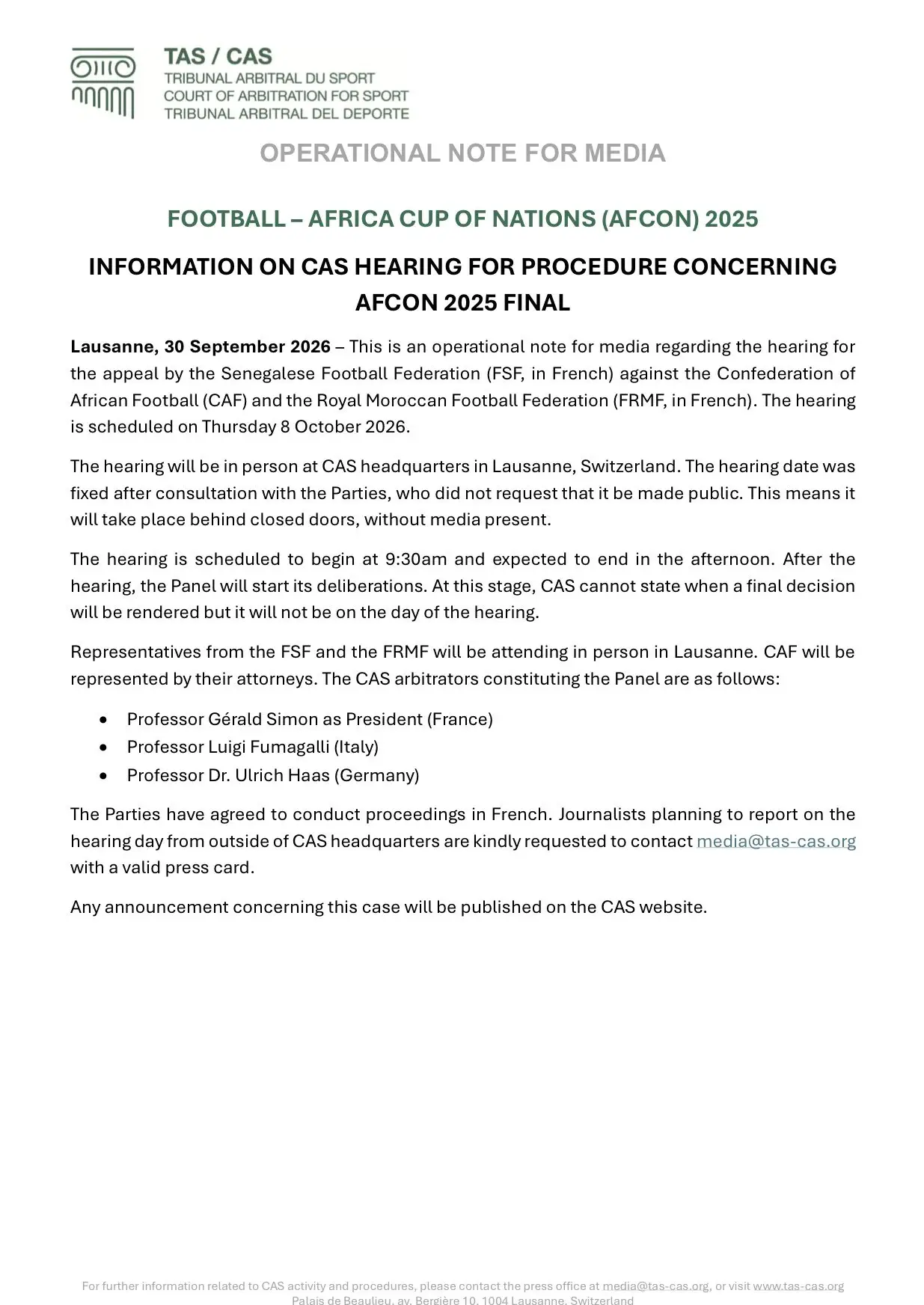
The Court of Arbitration for Sport (CAS) will hear Senegal‘s appeal against the decision that awarded the 2025 Africa Cup of Nations title to Morocco on 8 October 2026 in Lausanne, Switzerland.
The case, formally registered as CAS 2026/A/12295 Fédération Sénégalaise de Football (FSF) v CAF & FRMF, is scheduled for hearing on Thursday. CAS has confirmed that the proceedings will be held behind closed doors. (TAS CAS)
The dispute stems from the controversial AFCON final between Morocco and Senegal at the Prince Moulay Abdellah Stadium in Rabat on 18 January 2026.

Senegal challenge CAF ruling
Senegal initially won the final 1-0 after extra time, with Pape Gueye scoring early in the additional period after the match had ended goalless in normal time.
The final was overshadowed by an incident late in regulation time when referee Jean-Jacques Ndala awarded Morocco a penalty following a VAR review.
Senegal coach Pape Bouna Thiaw instructed his players to leave the pitch in protest, resulting in a lengthy delay before the team returned.
Morocco’s Brahim Díaz subsequently missed the penalty after goalkeeper Édouard Mendy made the save, before Gueye’s extra-time strike gave Senegal the victory on the field. CAF’s official match report recorded Senegal’s 1-0 triumph and second AFCON title at the time. (Confédération Africaine de Football)
CAF overturns final result
The controversy continued after the tournament when Morocco challenged the disciplinary handling of the walk-off.
CAF’s Disciplinary Board had sanctioned both federations and several individuals over incidents surrounding the final but did not initially overturn Senegal’s victory. The board suspended Thiaw for five CAF matches and fined him $100,000. (Confédération Africaine de Football)
The matter changed on 17 March, when the CAF Appeal Board upheld Morocco’s appeal and set aside the earlier Disciplinary Board decision.
The Appeal Board ruled that Senegal’s conduct fell under Articles 82 and 84 of the AFCON regulations and declared the team to have forfeited the final.
CAF subsequently recorded the match as a 3-0 victory for Morocco. (Confédération Africaine de Football)
Appeal moves to Lausanne
The Senegalese Football Federation subsequently took the matter to CAS, seeking to overturn CAF’s 17 March decision and have Senegal recognised as the winners of AFCON 2025.
CAS formally registered the appeal on 25 March, with CAF and the Royal Moroccan Football Federation (FRMF) named as respondents. (TAS CAS)
CAS later announced on 24 July that the hearing would take place on 8 October.
The case is now listed on the court’s official hearing schedule as one of its proceedings for that date. (TAS CAS)
Hearing will not produce immediate ruling
The hearing will be conducted behind closed doors, with the parties having not requested a public hearing.
CAS has also indicated that the panel will deliberate after the proceedings and that a decision will not be issued on the day of the hearing.
The outcome will determine the next stage of the dispute over the official status of the AFCON 2025 final and whether CAF’s forfeiture decision remains in force.
A long-running title dispute
The case has continued for more than eight months since the final in Rabat and has involved disciplinary proceedings at CAF before moving to the international sports tribunal.
Senegal’s appeal seeks to overturn the ruling that changed the official result from their 1-0 extra-time victory to a 3-0 forfeiture in favour of Morocco.
Meanwhile, the CAF Appeal Board decision remains the basis for Morocco being officially recorded as winners of the final. (Confédération Africaine de Football)
With the CAS hearing now scheduled, the long-running dispute over the AFCON 2025 final will enter another decisive legal stage on 8 October.
The post AFCON 2025: CAS to hear Senegal’s appeal over Morocco title decision appeared first on Made In Africa Sport.
-

 Athletics1 month ago
Abeokuta 10km Race winners praise organisers after ₦6m prize payout
-
Featured3 months ago
Bet9ja Foundation Ex-Internationals Cup: Babington Lift Giant Trophy, Pocket ₦2.5m After 3–1 Final Win
-
 Basketball7 months ago
PBA slaps ₱20k fine on Calvin Abueva for F2 upgrade vs Magnolia
-

 DLSU9 months ago
Shan Nunag shows composure beyond year in La Salle debut
-

 News9 months ago
Camilla Lamina shows calm leadership even off the bench
-
Football9 months ago
2026 Uganda Cup: The confirmed fixtures, venues & kick off times at round of 32
-
Foreign Pros9 months ago
‘Eric Chelle must pay compensation to quit Super Eagles post’
-
ADMU9 months ago
Palarong Pambansa MVP Baterbonia commits to Ateneo